
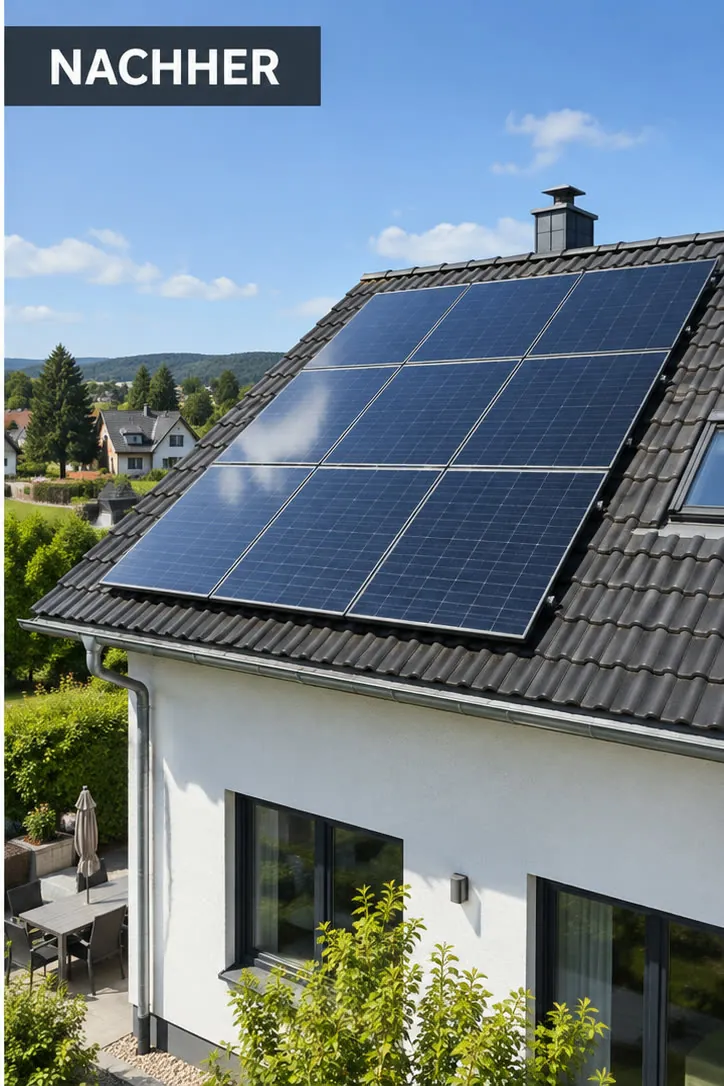
Professional solar panel cleaning in Dortmund & Ruhrgebiet — more performance for your photovoltaic system
A photovoltaic system is a long-term investment in sustainable energy. For your solar modules to keep working efficiently, they need regular care. Dust, pollen, bird droppings and industrial particles reduce light transmission — we clean gently using purified-water technology.
- Free initial consultation
- Gentle cleaning without high pressure
- Purified/pure water system — no limescale residue
- Material-appropriate for all module types
- Service for private and commercial customers
- Coverage in Dortmund and the Ruhr area
Why is cleaning a solar system important?
Photovoltaic modules work purely with the sunlight that reaches their surface. Any soiling on the solar glass reduces the amount of light reaching the solar cells. The cleaner the module surface, the better the modules can perform under the given weather conditions.
This isn't just about visible soiling such as bird droppings or moss. Fine dust, flower pollen, industrial particles or limescale residue can also build up over time and reduce the light transmission of the glass surface.
Localised soiling — such as from bird droppings — is particularly problematic, as it can shade individual areas of a module more heavily than others.
Your system is a long-term investment
A modern photovoltaic system is often installed with a planned service life of several decades. Professional cleaning supports long-term value retention while also enabling a better visual check for possible damage.
Benefits of professional solar panel cleaning
- Optimal energy yield
Clean module surfaces enable the best possible light absorption under the given weather and operating conditions.
- Preserving your investment
Regular care supports the long-term preservation of your photovoltaic system over its planned service life.
- Better visual inspection
During cleaning, obvious damage or irregularities can be more easily spotted and reported.
- Material-friendly cleaning
Professional methods avoid unnecessary stress on glass, frames, seals and anti-reflective coatings.
- Sustainability
A well-maintained photovoltaic system supports the long-term operation of your own renewable energy generation.
- • Significant fall risk when working on the roof
- • The wrong cleaning agents leave residue on coatings
- • Pressure washers stress seals and cable connections
- • Hard tap water causes limescale marks
- • Hard brushes permanently scratch anti-reflective coatings
Have your photovoltaic system professionally assessed
Whether cleaning makes sense depends on location, soiling, roof pitch and surroundings. We assess your system individually — free, no obligation, transparent.
Request your free consultation nowStructure of a solar module & module types
To clean a solar system correctly, you need to understand what it's made of. Every layer of a module has an important function and must be protected during cleaning.
How is a solar module built?
A modern photovoltaic module consists of several precisely matched layers — from outside to inside:
- 1Tempered solar glass— Protects all layers, must allow maximum light transmission
- 2Anti-reflective coating— Reduces light reflections — especially sensitive!
- 3Encapsulation material (EVA)— Protects and bonds the solar cells
- 4Solar cells— Generate electricity via the photovoltaic effect
- 5Backsheet / 2nd glass layer— Protection from the inside (glass-glass modules)
- 6Aluminium frame— Stability and secure mounting
- 7Junction box & cables— Electrical connections — don't stress them!
Many modern modules have an anti-reflective coating that reduces light reflections. It's more sensitive than ordinary glass. Never use: scouring pads, steel wool, aggressive cleaning agents or abrasives. A damaged anti-reflective layer can't be repaired.
Photovoltaic modules generate electrical voltage as soon as there's daylight — even if the inverter is switched off. Electrical checks, repairs or changes may only be carried out by qualified electricians. Cleaning doesn't involve any work on electrical components.
What types of photovoltaic modules are there?
Monocrystalline modules
Today the most commonly installed modules in the residential sector. High efficiency, uniform black appearance, sensitive to partial shading.
Polycrystalline modules
Recognisable by their bluish surface. Slightly lower efficiency but robust and economical technology. Uneven soiling can also affect power generation here.
Bifacial modules
Generate electricity on both front and back. Often used on ground-mounted systems, carports and industrial buildings. Cleaning is more complex as both sides need consideration.
Thin-film modules
Less common in the residential sector. Often on large commercial roofs and industrial halls. These modules also benefit from material-appropriate cleaning.
What types of soiling occur most frequently?
Bird droppings
One of the most problematic types of soiling. Can fully shade individual solar cells, dries stubbornly and is barely removed by rain.
Flower pollen
Large amounts of pollen can settle in spring. Combined with moisture this creates a sticky film that rain can barely remove.
Industrial & fine dust
In conurbations like Dortmund and the Ruhr area, fine dust, soot and industrial particles settle on modules — often barely visible but reducing output.
Limescale & mineral deposits
Limescale marks form after hard water dries. Rain with hard water makes the problem worse. That's why purified water is so important during cleaning.
Algae & lichen
Especially on flat-pitched modules or in humid regions. Lichen grows slowly but adheres particularly firmly and requires suitable removal methods.
Saharan dust
Saharan dust regularly reaches as far as NRW. Combined with rain, stubborn deposits form that further rainfall can barely remove.
What are hotspots? A hotspot is an area of a solar module that can heat up more than the surrounding areas — caused by strong partial shading or firmly adhering soiling. Persistently adhering soiling such as bird droppings is a good reason to have the system checked and cleaned if needed.
Influence of roof pitch on soiling
Rain can more easily wash away dust. Nevertheless, the following often remain:
- •Bird droppings
- •Tree resin
- •Pollen film
- •Limescale residue
Water stays on the modules longer. As a result, the following occur more often:
- •Water marks & limescale residue
- •Heavier dirt deposits
- •Biofilm & algae formation
- •Heavy soiling at module edges
Why the right cleaning method matters
Photovoltaic modules are highly developed technical products. A "just get it clean" approach can scratch the glass surface, damage anti-reflective coatings, stress seals and impair appearance and maintainability in the long run.
Purified water — the professional standard
Gentle, residue-free, no limescale
The most commonly used method today is cleaning with purified water — water from which nearly all dissolved minerals and salts have been removed. As a result, the water dries almost residue-free on the glass surface.
Tap water contains limescale, magnesium, sodium and other minerals, depending on the region. When it evaporates, these remain as residue on the glass — streaks, limescale marks, and new dirt particles stick more quickly. Purified water avoids this problem.
- Almost limescale-free
- No residue after drying
- No streaks
- Often no additional cleaning agents needed
- Especially gentle on anti-reflective coatings
Water is passed under pressure through a special membrane that retains most dissolved substances. The result is water with a very low mineral content — ideal for sensitive glass surfaces.
Dissolved minerals are removed using special resins. Also excellently suited for solar modules, glass facades, conservatories and glass roofs.
In summer, solar modules can get very hot. Sudden contact with much colder water can unnecessarily stress the material. Professional cleaning takes place in the morning, evening or under overcast skies.
Special cleaning brushes
Soft bristles, high water absorption, wide working width, no metal parts in the contact area. Special brushes remove dirt gently and distribute the purified water evenly over the module surface.
- Soft bristles
- No scratches
- Even cleaning
- Suitable for all module types
Carbon telescopic poles
Many roof systems can be cleaned from the ground or from safe working positions — without walking on the modules. Carbon poles are light, have long reach and allow precise, ergonomic work.
- Low weight
- Long reach
- No need to walk on the modules
- Safe working
Robotic cleaning
For very large photovoltaic systems, cleaning robots are sometimes used — often for solar parks, industrial sites or large hall roofs. Even cleaning of large areas with reduced physical strain.
Usually not economically necessary for private single-family homes.
Why pressure washers aren't suitable
Many owners consider cleaning solar modules with a pressure washer. In most cases this isn't advisable.
- Puts unnecessary strain on seals
- Affects plug connections
- Stresses frames and edges
- Hits sensitive module areas
- No controlled pressure possible
Why household cleaners aren't a good idea
Many glass or household cleaners contain surfactants, fragrances, alcohol, silicones or waxes. These can:
- Leave residue on the module surface
- Attract new dirt faster
- Cause streaks and marks
- Make additional cleaning necessary
- Affect anti-reflective coatings
Method comparison at a glance
| Method | Suitable for | Advantages | Notes |
|---|---|---|---|
| Purified water | Regular cleaning | Residue-free, material-friendly | Standard method |
| pure water system | Glass surfaces | Limescale-free, low streaking | Very common |
| Demineralised water | Sensitive modules | Low residue | Depending on technology |
| Soft special brushes | All module types | Gentle cleaning | Standard |
| Robotic cleaning | Large systems | Efficient on large areas | Mainly commercial |
| Pressure washer | Not usually | — | Risk to sensitive components |
| Household cleaner | Not recommended | — | Can leave residue |
How does professional solar panel cleaning work?
Professional solar panel cleaning involves far more than just cleaning the module surface. Every step is carefully planned — for material-friendly treatment and the safety of everyone involved.
Inspection & analysis
Module type, number, roof pitch, roof material, accessibility, degree of soiling, visible damage and surrounding conditions are checked. This analysis forms the basis for choosing the method.
Safety preparation
Securing the work area, choosing suitable access routes, setting up scaffolding or a lifting platform if required, fall protection, checking weather conditions.
Weather check
Ideal: overcast skies, cool morning hours or afternoon. Avoided: strong sunshine, storms, thunderstorms, frost and ice formation on the modules.
Carrying out the cleaning
Use of purified water, soft special brushes and carbon telescopic poles. Stubborn deposits are removed with extra care — without putting unnecessary strain on the glass surface.
Visual check during cleaning
Cracked glass, loose frames, heavy soiling, unusual discolouration and other irregularities can be spotted and reported to the owner. This doesn't replace an electrical inspection.
Final check
Even cleaning results, remaining soiling, visible irregularities and the proper condition of the work area are checked at the end.
Working at height per BG BAU guidelines
BG BAU (the German construction trade association) publishes extensive requirements for safely carrying out work at height. We comply with all regulations.
Environmentally friendly cleaning
Modern solar panel cleaning should be carried out not only effectively but also with environmental awareness.
- Purified water often allows cleaning without chemicals
- As little chemistry as possible — only when needed
- Suitable products — material-compatible & environmentally sound
- Efficient water use
- Careful handling of cleaning water per German water law (WHG)
- Guided by recommendations from the German Environment Agency
Cleaning is not the same as maintenance
Cleaning means: removing dirt, cleaning the module surface, visual inspection.
Maintenance additionally means: electrical measurements, checking the inverter, checking the wiring, insulation measurements, technical function checks.
These tasks belong exclusively to qualified electrical companies.
See the difference
Clean solar modules don't just look better — they can absorb more sunlight. The result of professional cleaning is immediately visible.
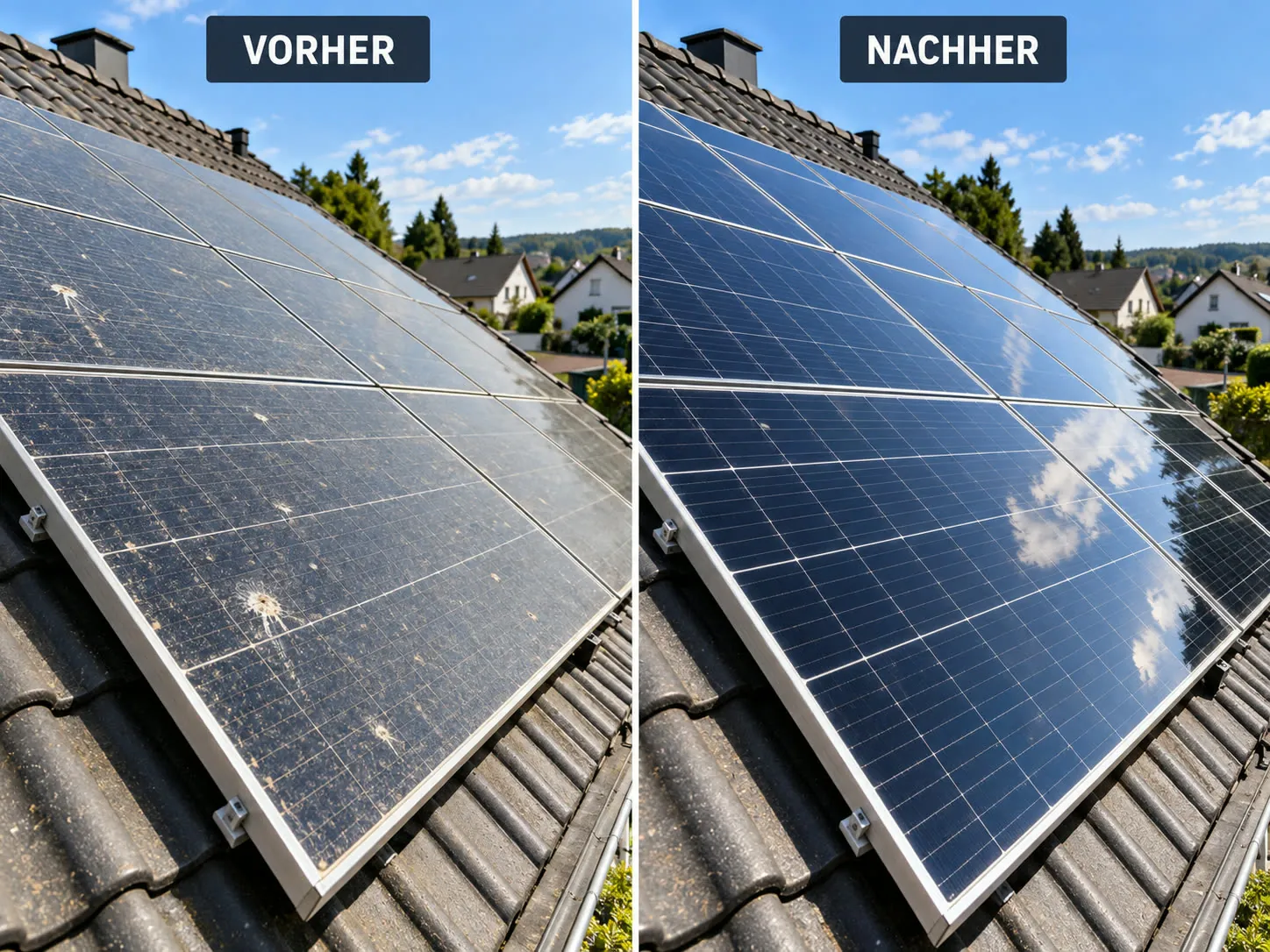
Illustrative example
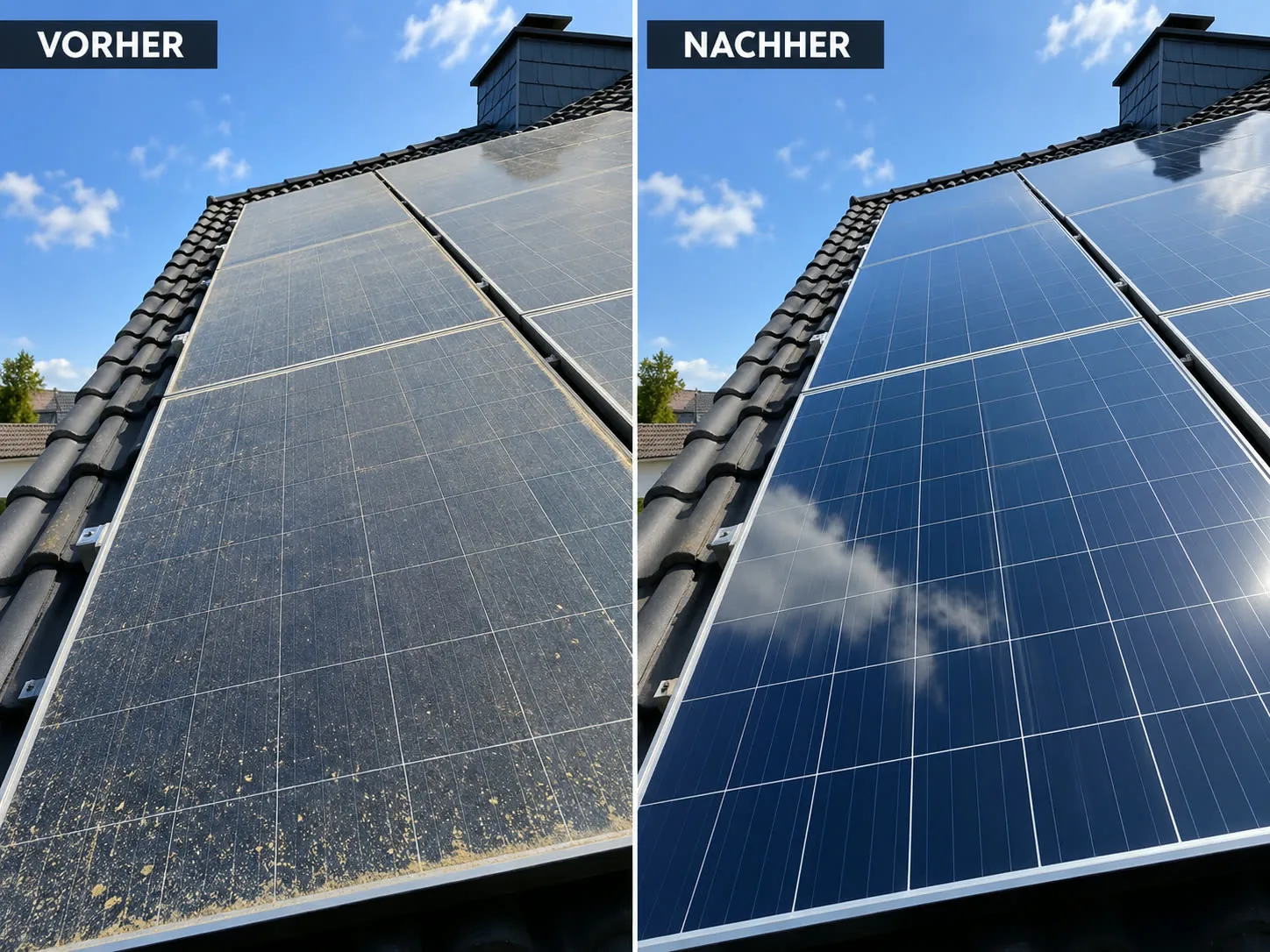
Illustrative example
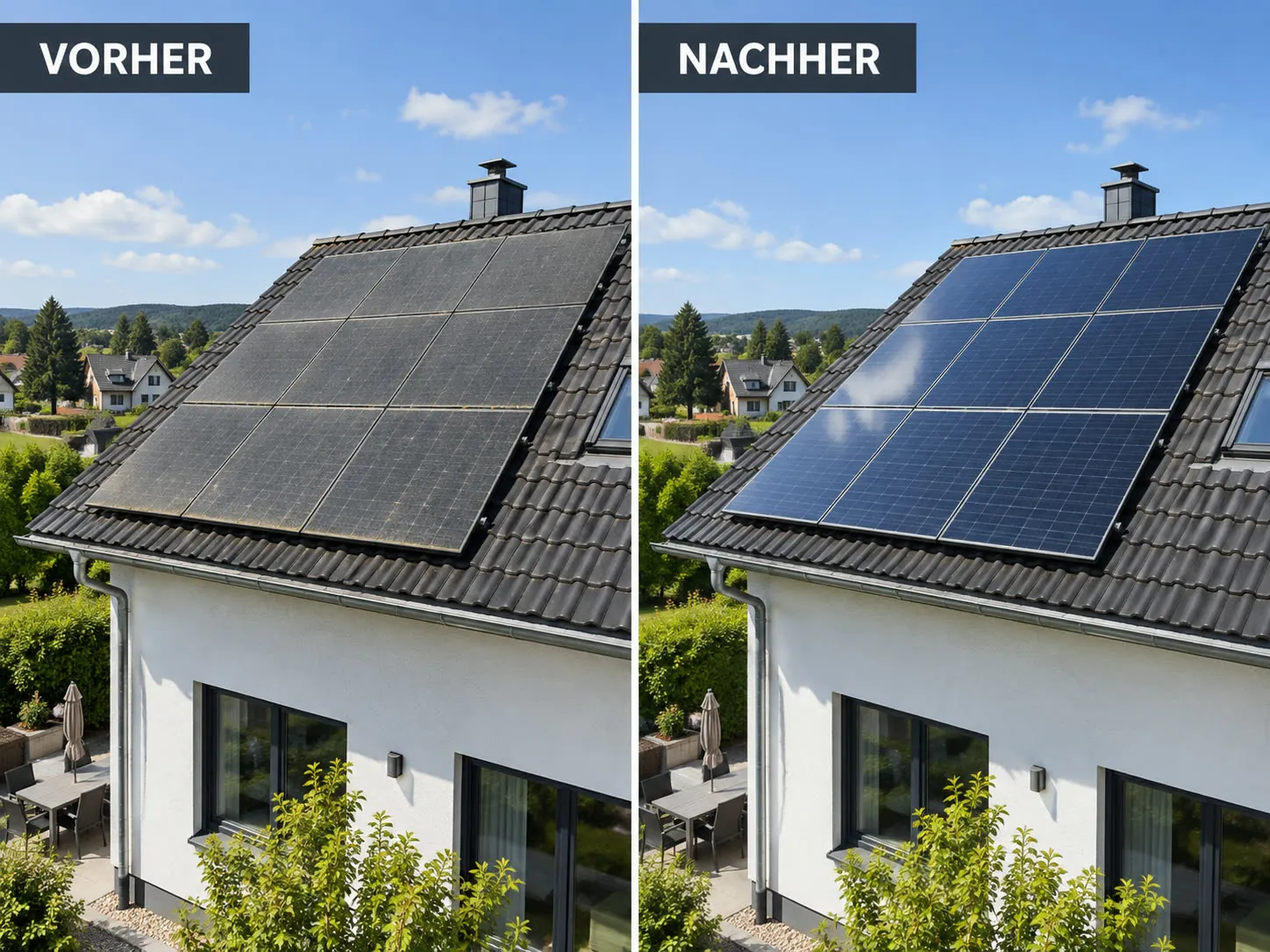
Illustrative example
Is professional solar panel cleaning worthwhile?
The honest answer is: it depends on the individual conditions of your system. A system on a steep roof in a clean residential area gets dirty differently than one near industry, under trees, or on a flat-pitched roof.
Which types of soiling have the biggest impact?
Which locations get dirty faster?
Worked example
Comparing two identical systems: System A with regular visual checks and cleaning as needed vs. System B without cleaning for many years, exposed to pollen, bird droppings and industrial dust. With System B, soiling remains permanently on the modules, makes visual inspection harder, and significantly increases the effort of a later cleaning.
How do you know cleaning might make sense?
Guide price from 149 €
All prices include 19% VAT and travel within 25 km of Dortmund. Beyond that: €0.95 per one-way km beyond 25 km.
Private customers: approximately 20% of labour costs are tax-deductible (§35a EStG).
Non-binding guide price. Binding fixed price after inspection or photo check.
Guide: Is solar panel cleaning worthwhile? (German)
What does professional solar panel cleaning cost?
Guide-price tiers by module count: from €149 for up to 10 modules, up to from €299 for 41–50 modules. From 51 modules: individual quote. Cherry picker priced by effort.
* Guide prices. Transparent guide prices after a free inspection.
Professional cleaning instead of experiments
Your photovoltaic system is a long-term investment. With the right cleaning method, you protect the glass surface, avoid limescale residue and preserve the value of your system.
Request your free consultation nowSolar panel cleaning in Dortmund & Ruhrgebiet
We offer our services to private and commercial customers in Dortmund as well as throughout the Ruhr region and North Rhine-Westphalia. We clean single-family homes, multi-family homes, commercial buildings, hall roofs and ground-mounted systems.
Why customers trust us
- Free initial consultation — always no obligation
- Purified-water technology — no limescale residue
- Soft special brushes — no scratches
- No unnecessary high-pressure stress
- Individual analysis before every cleaning
- Transparent guide prices, no hidden costs
- Work in line with BG BAU safety standards
- Environmentally sound working practices per WHG
- Local service in Dortmund & Ruhrgebiet
Frequently asked questions about solar panel cleaning
Answers to the most important questions — from costs and methods to safety and cost-effectiveness.
Everything from a single source
Professional solar panel cleaning for long-term value retention
Your photovoltaic system works for you every day. With professional cleaning, we help keep the modules clean and maintain the condition of your investment over the long term.
- Free initial consultation — always no obligation
- Gentle cleaning with modern purified-water technology
- Transparent guide prices — no hidden costs
- Service area: Dortmund & the Ruhr area
How heavily soiled is your solar system?
Have the condition checked beforehand — by photo or with a free on-site test service.